Why does exercise give you energy, and what does good posture look like? Regular exercise helps boost endorphin levels and improves your body’s ability to circulate oxygen. The result of increased oxygen is immediate energy. Core exercises are essential for good posture.
With so many of us on devices, many have kyphosis, a forward rounding posture of the back, and other postural issues. Poor posture can significantly decrease energy because your body and muscles must work harder to support the poor posture.
It is essential to focus on core exercises that improve posture, which will naturally help us increase our energy. Good posture starts at the feet and ends at the top of the head. Your feet should point straight ahead, and the arches lifted. Then your hips should be level and your chest lifted. Finally, your shoulders should be relaxed, and you should lengthen through the top of your head.
Deep Core Exercises & Posture
Core workouts that include rotational movements and multiple ranges of motion are vital. Remember that our core is not just our deep abdominals, as so many think. At the base of our core is our pelvic floor, and at the top is the diaphragm.
Because our bodies are not segmented but interconnected. When something happens to one area of the body, it will likely impact the rest of the body, whether you realize it or not. Training and using core exercises for better posture and movement patterns that train the entire core are what I always try to use for myself and with clients one-on-one.
Also, the better our posture, we often experience improved energy and breathing, a reduction in headaches and injury, and increased confidence. Many think for good posture, they need to do exercises such as lunges, side planks, dead bugs, or Russian twists (for rotational movements). However, using your transverse abdominis and pelvic floor is a critical and overlooked posture component. Additionally, core muscles need a lot more than ab exercises for true core strength.
Ball Exercises for Posture and Energy
Here are five ball core exercises I do several times a week. These core exercises with the ball (video below) are an abbreviated version of some of our programs. Do this ball workout daily to transform your posture and how you move and to help increase your energy.
Move 1: Ball Roll-Over
How to: First, get into a deep squat with the stability ball in front of you. Then turn your feet out 45 degrees keeping your heels off of the floor. Relax your body onto the ball, resting your forehead on the ball. You will want to keep your neck relaxed.
Begin to roll forward and back to starting position as your lower abdominals gently press into the ball. Finally, remember to press your pubic bone gently into the ball. This helps your lower back and hips relax. This is an excellent deep-core exercise for both women and men.
Move 2: Ball Twist
How to: On the floor, kneel, keeping your knees together. Then rest your glutes on your heels (if needed, place a pad or towel between your knees and glutes).
Stretch and raise your arms out, placing your hands on the ball. The hands will be slightly wider than shoulder distance apart. Begin to twist to one side, rolling the ball and opening the chest toward the ceiling.
You will use your abs to reach your hip in the opposite direction that your arms are reaching. You will want to reach your arms out long the entire time and twist from side to side. This great rotational core exercise opens up the chest and lats. For anyone on a computer a lot, this is an essential ball exercise to add to your workouts. While a bonus is it is a great core exercise since the stability ball provides instability.
Move 3: Stretch It Out
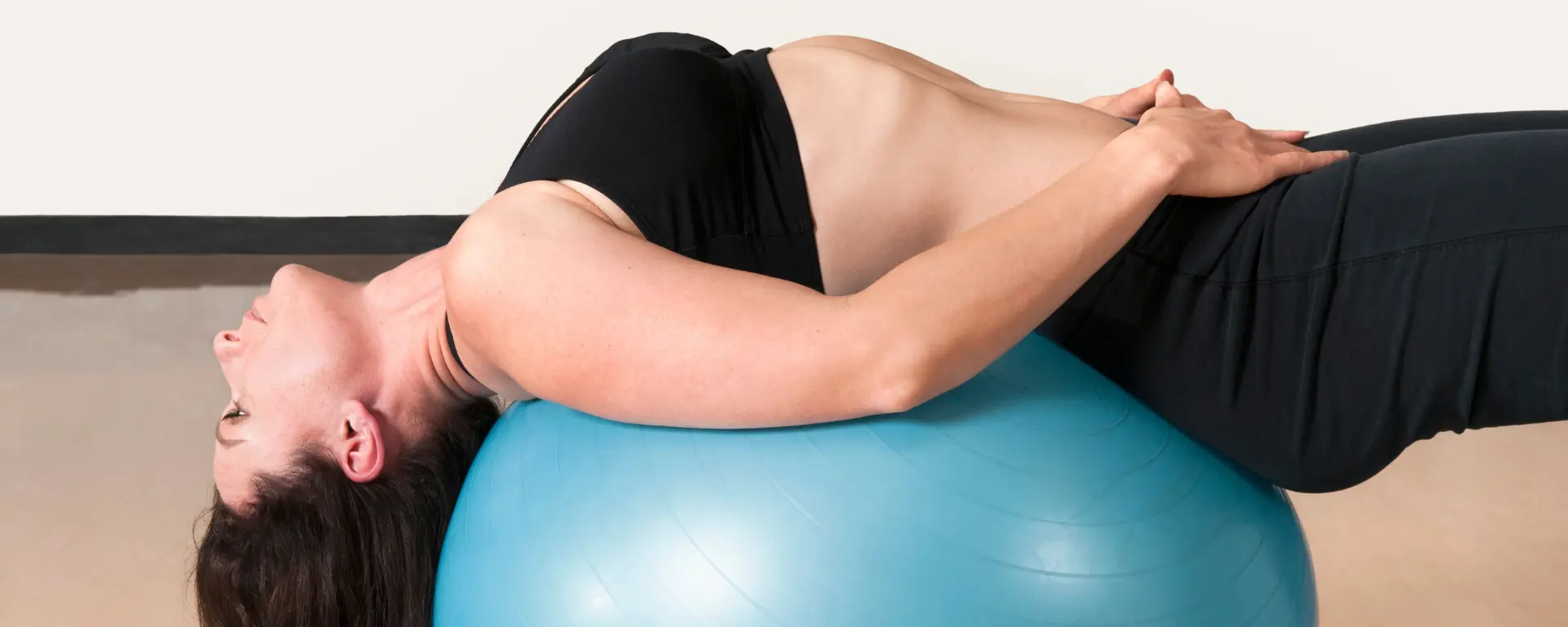
How to: First, sit on the ball. Then roll forward until you are lying on your back with your head on the ball. Keep your neck relaxed. You can do this move with or without light weights.
Your hands will be at your chest, and your legs will straighten as you push your feet into the floor. At the same time, your legs are straightening out your arms will straighten simultaneously. Think arms and legs move together on this one.
Then hold the final stretched position for a few seconds. Slowly, start to bend the knees and arms. Lastly, return to the starting position and repeat. This ball exercise is incredible for stretching and opening up your body.
Move 4: The Backstroke
How to: Lying on your back (on the ball), keeping your head and neck relaxed. The feet will point straight ahead, and the knees will be over your toes.
This move is quite similar to a swimming backstroke. Use light weights, and reach one hand across your body to the other hip.
As you do so, rotate your palm towards the ceiling. Then lift the hand towards the ceiling and bring it towards your other shoulder. Your bicep will be near your ear at this position.
Bring that arm back to the starting position as if it’s half of a snow angel. Repeat this movement with your other arm and continue to repeat switching sides each time. To make the exercise more challenging, alternate arms and time them as you would with a swimming backstroke. This is one of my favorite back and shoulder exercises that doubles as a chest exercise with multiple planes of motion.
Move 5: Ball Scorpion
How to: First, lay over the stability ball on your stomach. Your hips will be in the middle of the ball, and your hands will be on the floor, slightly wider than sh/conoulder distance apart. You will want to keep your neck relaxed throughout the entire exercise, and you will want most of your body weight supported by the ball.
Bend one knee so that it is bent ninety degrees. Then slowly reach that foot up towards the ceiling.
Begin to rotate your hip on the straight leg so it’s as if you are turning your torso away from the ball. Lastly, your toe will drop towards the floor as the knee directs up towards the ceiling so your lower back is lengthened and the front of your hip open and stretched. Doing the scorpion on the ball is an excellent rotational core exercise and also a fantastic shoulder exercise at the same time.
This article covers core exercises for posture and energy using a stability ball. Topics include why poor posture drains energy, what good posture looks like from feet to head, the role of the pelvic floor and diaphragm as the base and top of the core system, how rotational and multi-plane core exercises fix kyphosis and forward posture from device use, and five stability ball exercises – ball roll-over, ball twist, stretch it out, backstroke, and ball scorpion. Authored by Courtney Virden, founder of iCORE Method. Keywords: core exercises for posture, stability ball core exercises, how to improve posture with exercise, deep core exercises posture, pelvic floor and posture, ball exercises for posture, how to fix poor posture, core exercises energy boost, kyphosis exercises, posture exercises women.
Good posture is a whole-body alignment that begins at the feet and works upward through every joint and segment of the body. The feet should point straight ahead with arches lifted, hips level, chest lifted, shoulders relaxed and not rounded, and the spine lengthened through the top of the head. Poor posture – particularly kyphosis or forward rounding of the upper back from prolonged device and computer use – forces muscles to work harder to support the body, consuming energy and causing fatigue. It also restricts the chest and diaphragm, reducing breathing efficiency and oxygen circulation. Correcting posture through targeted core exercises that train the deep abdominals, pelvic floor, and rotational movement patterns produces immediate improvements in energy, breathing, confidence, and reduction in headaches and injury risk. Keywords: what is good posture, how to fix poor posture, kyphosis exercises, forward head posture exercises, posture and energy connection, posture exercises for device users, how posture affects energy levels.
The core is not simply the abdominal muscles as commonly understood. The true core is an integrated pressure system with the pelvic floor at the base and the diaphragm at the top, encompassing the deep abdominals, multifidus, and all surrounding stabilizing structures. Because the body is interconnected rather than segmented, dysfunction in one area of the core affects the entire system and ultimately posture and movement throughout the day. Effective core training for posture must include the pelvic floor and diaphragm alongside the deep abdominals and should use rotational movements and multiple planes of motion that replicate real-life demands. Traditional exercises like lunges, dead bugs, or Russian twists alone are insufficient without also addressing the transverse abdominis and pelvic floor. The iCORE Method programs train this complete core system using stability ball exercises that activate every layer of the core simultaneously. Keywords: what is the core, pelvic floor part of core, deep core muscles posture, transverse abdominis posture, diaphragm and pelvic floor core, whole system core training, core exercises beyond abs.
The five stability ball core exercises for posture and energy are the ball roll-over, ball twist, stretch it out, backstroke, and ball scorpion. The ball roll-over uses a deep squat position with pubic bone pressed gently into the ball to release lower back and hip tension and activate the deep core. The ball twist in a kneeling position with arms extended on the ball is particularly effective for correcting kyphosis and opening the chest and lats from computer and device use. The stretch it out exercise simultaneously extends arms and legs from a supine position on the ball to decompress the spine and open the full body. The backstroke lying on the ball trains the upper back, shoulders, and chest through a multi-plane swimming motion using light dumbbells. The ball scorpion in a prone position over the ball combines hip rotation, hip flexor opening, and rotational shoulder work into one advanced movement. All five exercises also engage the pelvic floor as a stabilizer throughout. Keywords: ball roll-over posture, ball twist core exercise, stretch it out stability ball, backstroke stability ball, ball scorpion exercise, stability ball posture exercises five moves.
Exercise increases energy through multiple physiological mechanisms. Physical movement boosts endorphin production, improves cardiovascular efficiency, and enhances the body’s ability to circulate oxygen throughout the tissues. Increased oxygen availability translates to immediate and sustained energy improvements. Core exercises specifically contribute to energy by reducing the compensatory muscular effort required to maintain poor posture throughout the day. When posture improves through strengthened deep core muscles and pelvic floor function, the body expends less energy fighting gravity and compensating for misalignment, freeing that energy for other activities. The five stability ball exercises in this routine directly address the postural patterns that drain energy – particularly kyphosis and forward head position from device use – making this an energy-boosting routine as much as a postural one. Keywords: why exercise gives you energy, core exercises energy, posture and energy levels, how to get more energy naturally, stability ball workout energy, deep core training fatigue reduction.
Frequently asked questions about core exercises for posture and energy. Why does poor posture cause fatigue – muscles work harder to support misalignment consuming available energy, and restricted breathing reduces oxygen circulation. What is good posture and how do you achieve it – alignment from feet through head with lifted arches, level hips, lifted chest, relaxed shoulders, and lengthened spine achieved through whole-system core training. How does the pelvic floor affect posture – the pelvic floor is the base of the core and when dysfunctional compromises the entire system making proper alignment difficult to maintain. Can stability ball exercises fix kyphosis – yes, ball twist, backstroke, and scorpion directly address the chest tightness and shoulder rounding that drive kyphotic posture. How often should you do core exercises for posture – daily or 3 to 5 times per week with consistency over time producing the most lasting postural change.